In legal language, synonyms are almost nonexistent because legal concepts must not be imprecise. Words can have similar yet distinct meanings. Here are a few examples.

In legal language, synonyms are almost nonexistent because legal concepts must not be imprecise. Words can have similar yet distinct meanings. Here are a few examples.

We have two verbs to express knowledge : “connaître” and “savoir”.
On a semantic level, ‘connaître’ entails having awareness of the existence of something, being able to identify it, and regarding it as real; whereas ‘savoir’ involves possessing a comprehensive understanding of something derived from learning, encompassing a collection of ideas and images constituting knowledge about the subject matter.

The days of the week in French are named after celestial bodies.
This reference to astronomy and mythology dates back to antiquity when the earliest astronomers identified seven wandering celestial bodies in the sky, which they observed moving. Then, in Roman civilization, the names of the planets in the solar system were also the names of important gods. To understand the meaning of each day’s name, just look at the clouds:

Be mindful of homophones in French. They are numerous and can easily cause confusion. Therefore, it’s crucial to pay attention to spelling in order to distinguish them

The richness and variety of the French language stem from the influences of neighboring languages. Which are the French words borrowed from German? Here are a few examples.

The French language often refers to animals to express the weather. The phrase ‘cold as a duck’ is used to describe intense cold, while ‘dog weather’ is used to describe very bad weather (wind, rain, etc.). Finally, the expression translated literally as ‘it’s raining like a cow peeing’ is used to express pouring rain.

France, steeped in tradition, has chosen to retain the base-20 numbering system from the number 70 onwards. See below:

Please note that in Belgium and Switzerland, the numbers 70 and 90 are logically expressed as “septante” and “nonante”, respectively. In Switzerland, this logical progression extends to 80, which is referred to as “huitante”. However, Belgium has opted to retain the term “quatre-vingts” for 80.
The terminology within the realm of French legal language is highly precise. Specifically, do not confuse the terms “légal,” “juridique,” and “judiciaire,” which may appear to be similar.

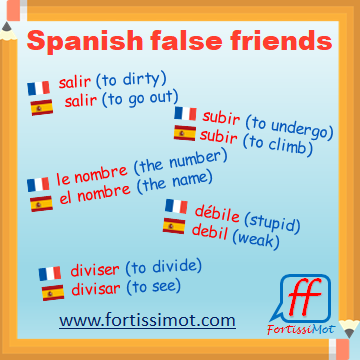
While it’s undeniable that French and English share the same linguistic origins, their similarity in appearance doesn’t always reflect similar meanings. Here are a few examples.